The Fitch
as a fuel treatment device that reformulates fuel. The Fitch doesn't make
good fuel better but "reconstitutes" degraded fuel.
"Degraded" doesn't necessarily mean that nasty, evil smelling
stuff you find in the tanks of neglected outboard boats. Immediately after
gasoline is made, it begins to degrade. Essentially, it tries to revert
back into its previous form. The longer between the time the fuel was
refined and you use it, the more degradation has occurred and the more
power and mileage is lost.
Really old
fuel is an extreme example but according the a source in the gas business,
it can be one to three weeks between the time the fuel is processed and it
gets to your station. How long it sits in the tank after than depends on
how much fuel that station sells. On top of that, the way fuel is stored
and transported can have an effect on how quickly it degrades and its
condition when you pump it into your tank.
The Fitch
uses a 19-metal heterogeneous metal alloy insert as a catalyst and APS
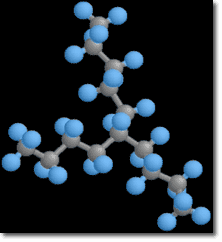
tells us converts elements in the degraded fuel to alkanes, which are
paraffins that contain hydrocarbons. Alkanes combust better than degraded
olefins and aromatic compounds, so you gain back some of what is lost. The
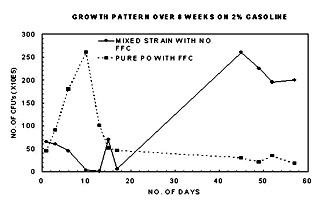
metallic alloy also reduces microbial action, which are little critters
that form and grow in the water that may be contained in gasoline and may
plug fuel filters.
How much
benefit you gain from the Fitch is directly proportional to the quality of
the fuel. APSI claims an average gain of 1 to 2.5 mpg, also saying their
product proves more useful and beneficial in the "real world" of
spotty fuel quality.
HOW IT WORKS
The Fitch catalyst process
works in a manner similar to the cracking process used in the petroleum
industry to make high octane gasolines.
Imagine a
bell-shaped curve representing the components of the fuel. The most
combustible materials are in the middle range and make up the majority of
the fuels composition but at either end there are elements that cause
ignition problems. The lighter components burn too fast causing
pre-ignition and the heaviest components burn slowly causing late ignition
resulting in smoke and carbon buildup-- it is these problem components on
which the catalyst works.
Through an
electro-chemical reaction the Fitch catalyst converts these lighter and heavier components into
energy producers rather than to excess smoke.
Refineries cannot
remove many poorly performing molecules to make a more ideal fuel. In
addition, once fuel leaves the refinery or is stored it is subject to
attack by oxygen, ozone, and microorganisms (bacteria, yeast, and mold)
that grow in the fuel. All these processes degrade the fuel to make a
poorer product that prevents engines from performing at optimum levels. The
Fitch Fuel Catalyst reformulates fuel prior to combustion on board the
vehicle, preventing oxygen and most diseases from attacking the fuel and
reversing any degradation that may have occurred prior to the fuel being
introduced to the vehicle. The Fitch Fuel Catalyst assists the combustion
process by insuring that fuel is highly uniform, potent, consistent, and
stable.
Full report test on the effects of the Fitch Fuel Catalyst
on Bacterial Growth.Click
Here
Tests On Fuel Quality And The Influence of the Fitch Fuel Catalyst on
Bacterial Growth in Gasoline Full Report
Click Here(This will open in a new window, just close to return
here)
The Fitch
Fuel Catalyst is composed of a heterogeneous metal alloy that is a true
catalyst by definition in that it affects, but does not become a part of,
the fuel. The Fitch® Fuel Catalyst improves the combustibility
of hydrocarbon fuels by treating the fuel immediately before it enters the
combustion chamber. As the fuel is exposed to Fitch® Fuel
Catalyst in the fuel tank of small engines or as it passes through a canister
containing the catalyst in the fuel line of larger engines, the catalyst
acts on the naturally degraded extreme ends of the fuel spectrum. The
catalyst acts on impurity molecules in fuel converting them into extremely
active small molecules which have the effect of cracking any long-chain
paraffins to form lower molecular weight saturated alkanes. As a result,
fuel burns cleaner and more completely, improving the combustion process.
This process is similar to the cracking process used to create different
fuels at an oil refinery.
By facilitating more
complete combustion, the Fitch® Fuel Catalyst improves fuel economy and increases power,
while reducing emissions. The use of the Fitch® Fuel Catalyst also
results in cleaner engine oil, reduced carbon buildup in the engine, easier
starting, reduced maintenance, and prolonged engine life.
The Fitch® Fuel Catalyst may be
used on any size internal combustion engine. The product is now in use on
thousands of engines worldwide ranging from small 1/4 horsepower string
trimmers to large commercial and marine engines in excess of 5,000
horsepower. The Fitch® Fuel Catalyst may be used with gasoline, diesel, methanol and
other liquid fuels.
On small
engines such as chain saws, lawn mowers and motorcycles, the Fitch® Fuel Catalyst is
installed directly into the fuel tank. All larger engines are treated with
an in-fuel line application the size of which is based on the horsepower
(or fuel flow) of the engine. The Fitch® Fuel Catalyst is maintenance-free and
will last for the life of the engine in non-commercial applications or
250,000 miles or 5,000 operating hours in commercial applications.
USE IT ON YOUR OWN VEHICLE OR EQUIPMENT
In order to
fully appreciate the Fitch® Fuel Catalyst you have to see it work for yourself. Drop an
F-2T unit into your chainsaw or trimmer or put an F-4T into your lawn
mower-or install an F-5T into your motorcycle or ATV. You will quickly
notice that your equipment will start easier, smoke less and have more
power. Then install a Fitch® Fuel Catalyst in-line unit on your car or truck after
establishing a fuel mileage baseline and monitor the results.
HOW WILL I KNOW THAT IT IS WORKING?
Certain
things can be quickly observed. The engine may run smoother and quieter.
More power may be felt and there may be less exhaust smoke. However the
most objective way to measure is by having a baseline of information for
comparison of "before" and "after." This data can be
based on fuel economy (miles per gallon), emissions of Hydrocarbons (HC)
and carbon monoxide (CO), engine oil analysis, or performance.
A PERMANENT FUEL STABILIZER
For more information about the Fitch Fuel Catalyst's ability
to stabilize fuel Click
Here!
Call
Toll Free for more Information
or To Order
1-866-GOFITCH
1-866-463-4824